(And Why It’s Actually a Part of Healing)
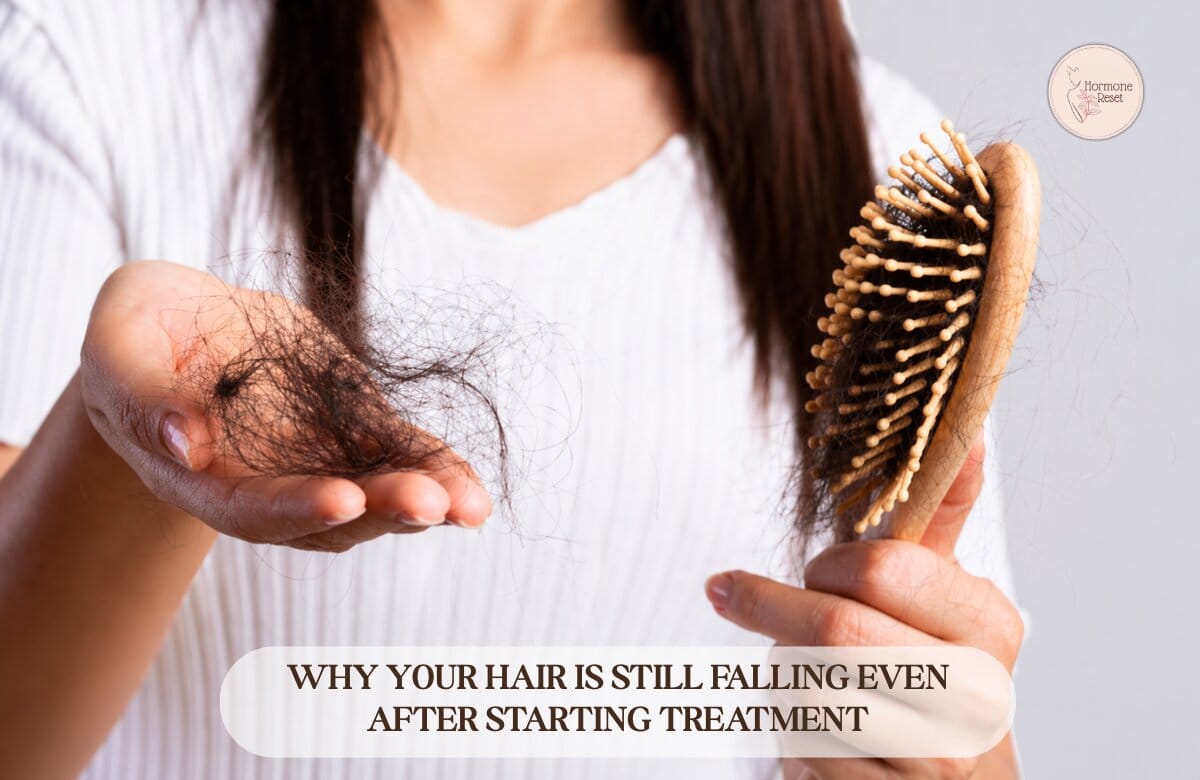
“Doctor… I’m following everything. Diet, supplements, routine… but my hair fall hasn’t stopped.”
She looked worried. And honestly, a little defeated.
If you’ve ever felt this way – you’re not alone.
Hair fall is not just physical.
It slowly starts affecting your confidence, your mood, even how you feel when you look in the mirror.
And when you’re doing everything right… but still seeing hair fall?
That’s the hardest part.
But here’s what I want you to understand first:
This doesn’t mean your treatment is not working.
In many cases… it means your body has just started healing.
The Part No One Explains: Hair Has Its Own Timeline
Hair doesn’t respond instantly.
It follows its own cycle — almost like a delayed reaction system.
So when your body goes through stress (poor nutrition, hormonal imbalance, gut issues, emotional stress), your hair quietly shifts into a resting phase.
And then… it falls.
Not immediately.
But 2–3 months later.
So what you’re seeing today?
It’s often your body processing something from the past.
That’s why even after starting treatment, hair fall continues for some time.
And yes… that’s completely normal
Then Why Did My Hair Fall Increase After Starting Treatment?
This is where most people panic.
Because sometimes, after starting a functional medicine plan, hair fall doesn’t just continue… It increases.
And that feels scary.
What’s Really Happening Inside Your Body
When you start working on:
- Gut healing
- Detoxification
- Removing inflammatory foods
- Improving metabolism
Your body doesn’t just “fix hair.”
It starts cleaning house.
Toxins, inflammation, stored waste, even unhealthy gut bacteria —
everything begins to get cleared.This phase is often called: Detox phase or die-off response
Why Hair Fall Increases During This Phase
Think of it like this:
Your body has limited energy. And right now, it chooses: “Let me heal first… beauty can wait.”
So what happens?
- Nutrients are used for repair
- Detox pathways become active
- Hair growth is temporarily paused
- Hair enters shedding phase
Result?
More hair fall — temporarily
Read This Carefully (Because This Changes Everything)
This phase does NOT mean:
- Treatment is failing or You’re doing something wrong
It often means:
✔ Your body is responding
✔ Healing has started
✔ Internal repair is happening
This is not regression. This is transition.
How Long Does This Phase Last?
Usually: 2–6 weeks
After that, things begin to settle.Hair fall reduces.
And slowly… regrowth begins.
What You Should Do (Very Important)
Instead of stopping everything midway, support your body better:
- Drink enough water (your detox pathways need it)
- Don’t skip protein (hair still needs building blocks)
- Avoid extreme dieting
- Rest more than usual
- Be gentle with your hair
And most importantly… Don’t panic.
But Let’s Go Deeper – Why Did Hair Fall Start in the First Place?
Hair fall is rarely due to just one reason.
It’s usually a combination of internal imbalances.
Some of the most common root causes I see:
- Low iron (ferritin) – very common in women
- Vitamin B12 & Vitamin D deficiency
- Thyroid imbalance
- Insulin resistance / PCOS
- Poor gut health & absorption issues
- Chronic stress and high cortisol
- Autoimmune conditions like alopecia
Hair is often the last place the body invests in — so when something is off, it shows here first.
A Very Common but Ignored Cause: Insulin Resistance
This is something I see very often in women.
And many don’t even realize it.
When your body becomes insulin resistant, your cells stop responding properly to insulin.
So the body produces more of it.
And this affects hair in ways most people don’t expect.
What Happens When Insulin Is High?
- It increases androgen (male hormone) levels
- It disrupts the hair growth cycle
- It weakens hair follicles over time
This is why many women notice:
- Hair thinning around the crown
- Acne
- Irregular periods
- Weight gain (especially around the abdomen)
Why This Matters for Hair
Even if you are taking supplements…
If insulin is not balanced, hair fall may continue.
What You Can Do
Simple changes can make a big difference:
- Don’t skip meals (prevents sugar crashes)
- Include protein in every meal
- Avoid excess sugar and refined carbs
- Move your body daily (even walking helps
- Maintain good sleep
These steps improve insulin sensitivity – and that directly supports hair growth.
What Should You Actually Check? (Important Tests)
Instead of guessing, it’s always better to check.
I usually recommend:
Nutrient levels:
- Serum Ferritin
- Vitamin B12
- Vitamin D
- Zinc
Hormonal markers:
- Thyroid (TSH, Free T3, Free T4)
- Fasting insulin
- HbA1c
Because many times… Hair fall improves only when these are corrected.
Now Let’s Talk About Food (Because It Truly Matters)
Hair is not just about oils and shampoos.
It is built from what you eat.
Your hair needs:
Protein
(Lentils, eggs, legumes)
→ forms the structure of hair
Iron-rich foods
(Spinach, beetroot, dates, sesame)
→ supports oxygen supply to follicles
Healthy fats
(Flaxseeds, walnuts, nuts)
→ reduce inflammationVitamin C
(Amla, citrus fruits)
→ helps absorb iron better
What About Supplements?
Sometimes food alone is not enough – especially if levels are low.
Depending on the person, support may include:
- Iron (if ferritin is low)
- Vitamin B12
- Vitamin D
- Zinc
- Omega-3
- Biotin / amino acids
But here’s the key: Supplements should be targeted, not random
But There’s One More Piece Most People Miss
Even after fixing diet, supplements, and gut…
Some people still struggle.
Why? Because healing is not just physical.
The Emotional Brain: Your Limbic System
Let me explain something very simply.
Your brain has a part called the limbic system.
It’s your emotional center.
It decides:
- Are you safe?
- Are you stressed?
- Should the body repair… or just survive?
When This System Is Overactive…
Your body stays in stress mode.
Even if everything looks “fine” on the outside.
Digestion slowsAnd in stress mode, the body does one thing: It prioritizes survival over growth means:
- Digestion slows
- Hormones get imbalanced
- Hair growth stops
Emotional Blockages: The Silent Factor
Most women don’t realize how much they’re carrying:
- Overthinking
- Stress
- Suppressed emotions
- Constant mental load
And the body doesn’t ignore this.
It translates emotions into biology.
Stress → Hormones → Hair fall
Signs This May Be Affecting You
- You feel constantly “on” or anxious
- You struggle to relax
- Your sleep isn’t deep
- Hair fall increases during stressful phases
If this feels familiar… your body is not just tired.
It’s overwhelmed.
How Do You Fix This?
Not with more supplements.
But by telling your body: “You’re safe now.”
Simple Ways to Calm the Limbic System
You don’t need complicated routines.
Start here:
1. Emotional release
Write your thoughts. Don’t filter. Just release.
2. Breath work
5–10 minutes of slow breathing daily.
3. Small pauses in the day
Even 2 minutes of doing nothing helps.
4. Grounding
Walk barefoot. Be in sunlight.
Meditation (The Game-Changer)
This is not just “relaxation.”
This is rewiring your brain.
Just sit quietly for 10–15 minutes.
No perfection needed.
Just breathe. Observe.
Over time:
- Stress hormones reduce
- Mind slows down
- Body shifts into healing mode
A New-Age Support: Red Light Therapy
This is something many people are now exploring.
Red light therapy (LLLT) works by:
- Improving blood circulation to scalp
- Stimulating hair follicles
- Supporting cellular energy
It’s not a replacement for root cause healing…
But it can be a good supportive tool alongside your plan.
When Will You See Results?
This is the part that needs patience.
Most women start noticing:
- Baby hairs near the hairline
- Less hair fall while washing
- Better hair thickness
After about:3–4 months of consistency
And This Is Where Hair Growth Begins
Because here’s the truth: Hair grows in a body that feels safe.
Not in a body that is constantly stressed, rushing, or overwhelmed.
Final Thought (Read This Slowly)
Your hair is not the problem.
It’s a messenger.
It reflects:
- How your body feels
- How your mind feels
- How supported your system is
So instead of asking: “Why is my hair falling?”
Start asking: “What is my body trying to tell me?”
Because when you:
- Nourish your body
- Support your gut
- Balance your hormones
- Calm your mind
Hair growth is not forced.
It naturally follows.
And sometimes…
The real treatment is not another product. It’s giving your body the safety it has been asking for.
References
Hair Growth Cycle & Telogen Effluvium
- Headington, J. T. (1993). Telogen Effluvium: New Concepts and Review.
Journal of the American Academy of Dermatology.
https://pubmed.ncbi.nlm.nih.gov/8360899/ - Malkud, S. (2015). Telogen Effluvium: A Review.
Journal of Clinical and Diagnostic Research.
https://www.ncbi.nlm.nih.gov/pmc/articles/PMC4606321/ - Stenn, K. S., & Paus, R. (2001). Controls of Hair Follicle Cycling.
Physiological Reviews.
https://pubmed.ncbi.nlm.nih.gov/11152763/ - Harrison, S., & Sinclair, R. (2002). Telogen Effluvium.
Clinical and Experimental Dermatology.
https://pubmed.ncbi.nlm.nih.gov/12190640/
Nutritional Deficiencies & Hair Loss
- Almohanna, H. M., et al. (2019). Nutritional Deficiencies and Hair Loss: A Review.
Dermatology and Therapy.
https://www.ncbi.nlm.nih.gov/pmc/articles/PMC6380979/ - Trost, L. B., Bergfeld, W. F., & Calogeras, E. (2006). Iron Deficiency and Hair Loss.
Journal of the American Academy of Dermatology.
https://pubmed.ncbi.nlm.nih.gov/16635664/ - Rushton, D. H. (2002). Nutritional Factors and Hair Loss.
Clinical and Experimental Dermatology.
https://pubmed.ncbi.nlm.nih.gov/12190641/
Stress & Hair Loss
- Arck, P. C., et al. (2003). Stress Induces Hair Growth Inhibition.
American Journal of Pathology.
https://www.ncbi.nlm.nih.gov/pmc/articles/PMC1868204/ - Paus, R., & Cotsarelis, G. (1999). The Biology of Hair Follicles.
New England Journal of Medicine.
https://pubmed.ncbi.nlm.nih.gov/10477740/
Yoga & Stress Reduction
- Ross, A., & Thomas, S. (2010). The Health Benefits of Yoga and Exercise.
Journal of Alternative and Complementary Medicine
https://pubmed.ncbi.nlm.nih.gov/20105062/ - Yoga for Stress Reduction – Review Study
https://www.ncbi.nlm.nih.gov/pmc/articles/PMC3193654/
Harrison, S., & Sinclair, R. (2002). Telogen Effluvium.
Clinical and Experimental Dermatology.
https://pubmed.ncbi.nlm.nih.gov/12190640/

Leave a Reply